


Preconstructed Commander decks: price and bracket
By The Tapt team · updated
How much a preconstructed Commander deck costs, what it contains and what bracket it plays at: all of it reads on a precon's page in Tapt, with local prices.

A preconstructed Commander deck, or "precon", is a hundred-card deck sold ready-made, with its commander, ready to play without opening a single sleeve. It is the entry door for many players: a single box, a clear theme, and a game possible from the very first evening. It is also an excellent starting point for anyone who wants to build a more personal deck, because a hundred-card list thought out by a designer transforms more easily than you would imagine.
Tapt gathers nearly two hundred of these decks in its preconstructed decks section. This guide explains what the page contains, how to read a precon's page (its price to rebuild, its value at reference prices, its statistics and its bracket marker) and how to use it to buy, play or upgrade a deck.
What a precon is, and why people care
A Commander precon is designed by Wizards of the Coast around a commander, with a colour identity, a game plan and a mana base already tuned. It is played as is. The cards are meant to work together, which is rare in a deck assembled in a hurry.
Three reasons explain their popularity:
- The entry price. A single box replaces dozens of separate purchases.
- Consistency. The deck has a clear plan, with spells, lands and mana sources in proportion.
- The play level. A precon generally falls at the level of a relaxed game, which makes it a good yardstick for a table of beginners.
Tapt presents them by linking them to what they really cost at local stores, which a box sold in a shop does not always tell you: the price of its cards one by one, and what it would cost to rebuild the deck if you took it apart.
The list page
The Preconstructed decks page introduces itself in one sentence: "Commander decks sold ready-made. Open one to see its full list, what it costs at local stores, and what you are missing to rebuild it." The lists are provided by MTGJSON, a public database of Magic cards, and they were retrieved on October 30, 2026. At the time of the screenshot, the page counted 198 decks.
Each deck appears as a card that shows the commander's artwork, the "Commander" label, the deck's name (for example "Calling All Angels"), the commander's name (here Giada, Font of Hope), the number of cards (100) and the release date. The most recent decks come first: you find the decks released on October 2, 2026, then those of September 28, August 10 and June. Some products exist in several versions: two decks with the same theme appear side by side when the product has a collector edition.

Reading a precon's page
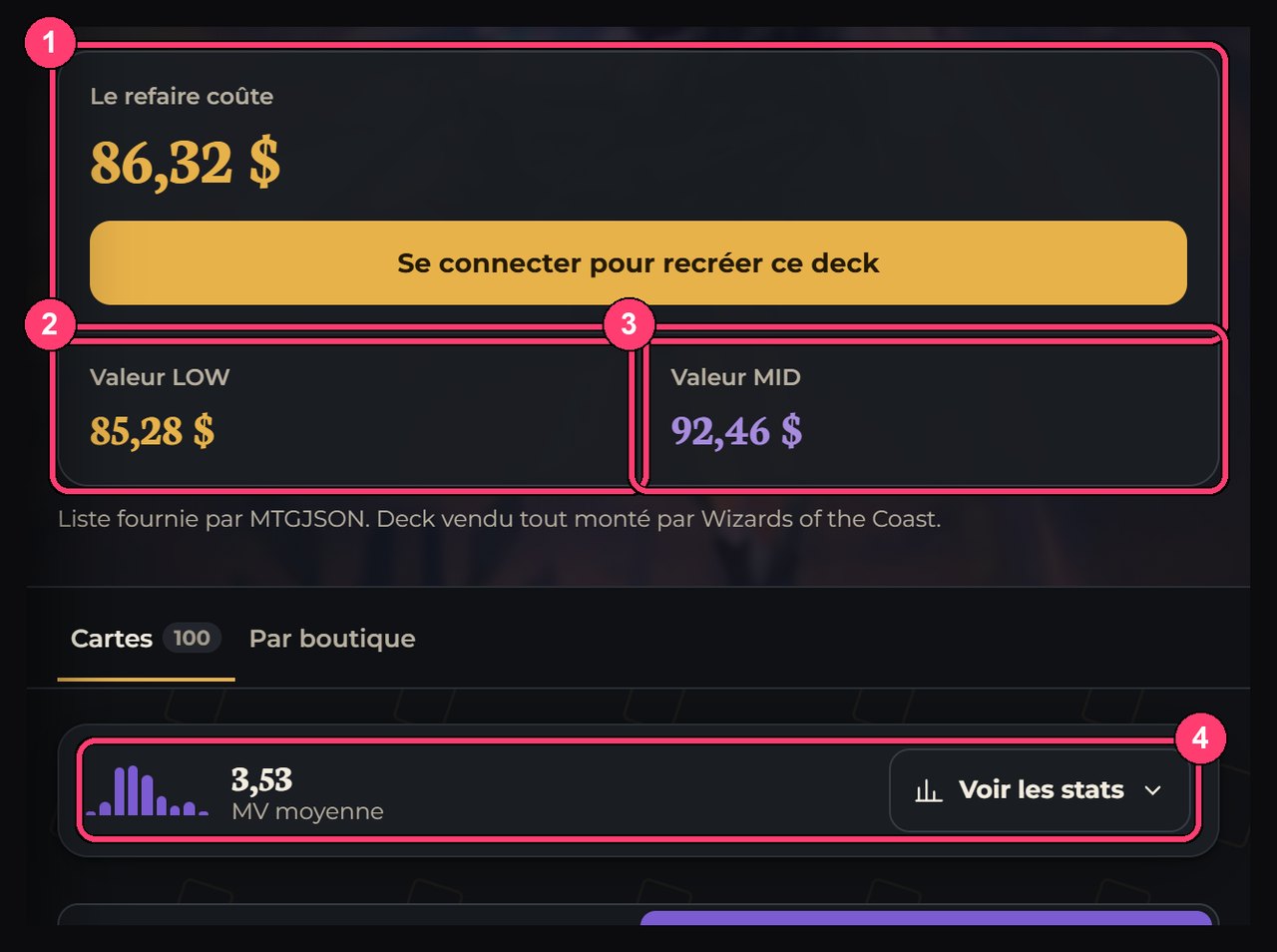
By opening a deck, you land on a page that starts with the essentials. Take the example of Calling All Angels, a 100-card deck released on October 2, 2026 and led by Giada, Font of Hope. The header shows three figures:
- Rebuilding it costs $86.32. The price to gather the deck's cards at local stores.
- LOW value: $85.28. The deck's value calculated at LOW reference prices, the bottom of the market.
- MID value: $92.46. The same list calculated at MID prices, the middle of the market.
These figures are dated reference points: they move with store prices. To know how LOW, MID and HIGH are computed, read the page How to read LOW and MID prices: only cards in stock and in Near Mint condition are counted, and a store that has ten copies of a card counts only once.
A "Sign in to recreate this deck" button turns the precon into a deck in your account, to open it in the editor and modify it. It requires a free account, because the deck is then yours. The page also recalls the source: "List provided by MTGJSON. Deck sold ready-made by Wizards of the Coast", with the credit of the artist of the header artwork.
The tabs and the statistics
Under the header, two tabs organize the page:
- Cards (100): the full deck list, sorted by type (creatures, spells, lands and so on). A button lets you choose between the Stacks view, which shows the artwork, and the List view, more compact.
- By store: the buying angle. That is where you see where to find the cards, store by store.
A band of figures sums up the deck at a glance. For Calling All Angels: an average mana value (MV) of 3.53, 62 spells, 38 lands, and a bracket marker of "1 or 2". The "See stats" link unfolds a panel with several ways to read the deck:
- Mana curve: how many cards at each mana cost, to judge whether the deck is fast or heavy.
- Types: the split between creatures, enchantments, artifacts and other types.
- Colors: the colours of the deck's cards.
- Color sources: how many cards produce each colour (lands and mana sources), and how many mana symbols the spells require. A heavily demanded colour with few sources is underpowered.
- Functions: the cards' roles, according to Scryfall. A card that does two things counts in both.
- Bracket: the power level marker, detailed below.
These statistics answer concrete questions. If you want to improve the deck, the mana curve tells you where it is heavy, the colour sources where it stumbles, and the functions what it lacks, for example card draw or removal.
A precon's bracket marker
Each precon carries a bracket marker, computed as on your own decks. It is presented as a floor, not a verdict: Tapt says what it can prove, and lets you conclude with your table. The page's panel goes through what it checks:
- Mass land denial: none before bracket 4.
- Extra turns: what matters is chaining them.
- Two-card combos: none before bracket 3. The combos come from Commander Spellbook.
For Calling All Angels, the marker shows "1 or 2", which is typical of a ready-made deck: few or no cards from the Game Changers list, no two-card combo. The detail of the system is in the article on Commander brackets and on the Commander Brackets page. To understand what a combo is and how to search for them, read the Commander combos guide.
A bracket 2 precon is an excellent yardstick: if your homebrew deck plays clearly stronger, you will know by comparing its list to a precon's.
Prices per card
In the Cards tab, each row shows the card, its edition and number (for example "FDC #12" for Angel of the Ruins) and three reference prices: LOW, MID and HIGH. For that card: $0.50, $0.60 and $0.99. A more sought-after card, like Norn's Choirmaster, shows $4.49, $5.20 and $5.49.
These prices tell you where the deck's value is concentrated. In a precon, a few cards weigh much more than the others, which often sell for a few tens of cents. Knowing which ones helps you decide whether to buy the whole deck back or only the pieces you are missing.

A worked example
Let us go back to the three amounts for Calling All Angels: the deck can be rebuilt for $86.32, its LOW value is $85.28 and its MID value $92.46. The price to rebuild it sits between the two reference values, and closer to the LOW. That is logical: it is computed from what is really in stock at local stores, whereas the LOW is a theoretical card-by-card market floor and the MID a middle price.
The gap between the LOW and the MID, a little over seven dollars on the whole deck, says something useful: for this precon, prices seem fairly close from one store to another. A deck whose LOW and MID values are very far apart would be a deck where the choice of store weighs heavily, and so where a detailed comparison pays off more.
These figures also answer the question many players ask in front of a box: "is it cheaper to buy the cards back one by one?" Compare the price to rebuild the deck with the box's price at your store, and you have today's answer, which can change from one week to the next. The page gives you today's figure rather than an impression.
Three ways to use a precon
To buy. Compare the price to rebuild the deck with that of a box sold in stores, which you will find at your shop. If the price of the single cards is clearly lower than the box's, you can consider buying back only the ones you are missing. To price a purchase across several stores, paste the list into the deck comparator: it gives you the total per store and a purchase suggestion that accounts for shipping.
To play. Play it as is at a table of players discovering Commander, or announce its bracket when you take it out: a precon is rarely above bracket 2.
To upgrade. Spot the weakest cards thanks to the statistics (a curve that is too heavy, an underpowered colour), replace them one by one, and keep the commander and the game plan. A dozen well-chosen changes transform a precon without making it unrecognizable. Keep an eye on the bracket: every Game Changer you add brings the deck closer to bracket 3.
Variants that cause confusion
Tapt's list sometimes contains two versions of the same deck: the standard version and a collector edition (Collector's Edition). The in-game contents are generally the same, but some cards are in a special version there, which changes the price. Before buying, look at which of the two you want, and compare prices like for like.
Another trap: a precon contains cards in several printings. When you buy them back one by one, check the edition and the finish. The guide to comparing the price of a Magic card explains how to filter.

Frequently asked questions
Where do the precon lists come from?
From MTGJSON, a public database of Magic cards. The lists were retrieved on October 30, 2026.
Are the displayed prices those of a new box?
No. Tapt shows what the cards cost one by one at local stores, not the price of a box sold in a shop. It is a different and complementary piece of information.
What does "Rebuilding it costs" mean?
It is the price to gather the deck's cards at local stores. Next to it, the LOW and MID values add up each card's reference prices, at the bottom and the middle of the market.
Can a precon be modified in Tapt?
Yes: the "Sign in to recreate this deck" button turns it into a deck in your account, which you modify in the editor. A free account is needed.
Why is the displayed bracket "1 or 2"?
Because Tapt gives a floor and not a verdict. It finds neither excess Game Changers, nor a two-card combo, nor mass land denial, so the deck can be at the lowest levels, and you confirm with your table.
Going further
Open the list of preconstructed decks, pick a commander that appeals to you and read its page down to the statistics. If you then want to compare it with a deck of your own, paste its list into the deck comparator and place its level with the article on brackets.
- preconstructed Commander deck
- Commander precon
- precon price
- rebuild a precon
- precon bracket
- 100-card Commander deck
Comments 0
Sign in or create your account to leave a comment.
No comments yet.