


Commander combos: find them, read them, place them
By The Tapt team · updated
How to read a Commander combo, look up the ones in your cards in Tapt's library and know what a two-card combo changes to your deck's level.

A combo, in Commander, is a small group of cards that together produce an effect none of them can produce alone: an infinite amount of mana, endless card draw, or an immediate win. Some players build their whole deck around them, others play one by accident without knowing it, and almost everyone has been caught off guard by a combo they did not see coming. Knowing how to spot them, read them and talk about them at your table is part of the game.
The Tapt combo library gathers a thousand of the most played combos in Commander. This guide explains how it works, how to read a combo's page, how to search for the ones that concern your deck, what the vocabulary found there means and why two-card combos weigh on a deck's power level.
What a combo is, in simple terms
A combo is a sequence of actions that loops back on itself. In the best case it is played with two or three cards, and all you need is to have them on the table at the right time. Three outcomes come up often:
- An infinite loop: an action restarts endlessly and produces something at each turn of the loop (mana, draws, tokens, life points).
- A direct win: the combo ends the game, for example by making every opponent lose all their life or by emptying a player's library.
- A disproportionate advantage: it does not win by itself, but provides infinite resources that you then spend with another card.
Most combos have one card that makes "the loop" and another that "ends it": one triggers, the other converts into a win. When we say a combo is "two-card", we mean it fits entirely in two cards, with nothing else to set up. It is the easiest to assemble, and the most important to know about in Commander.
What the Tapt library shows
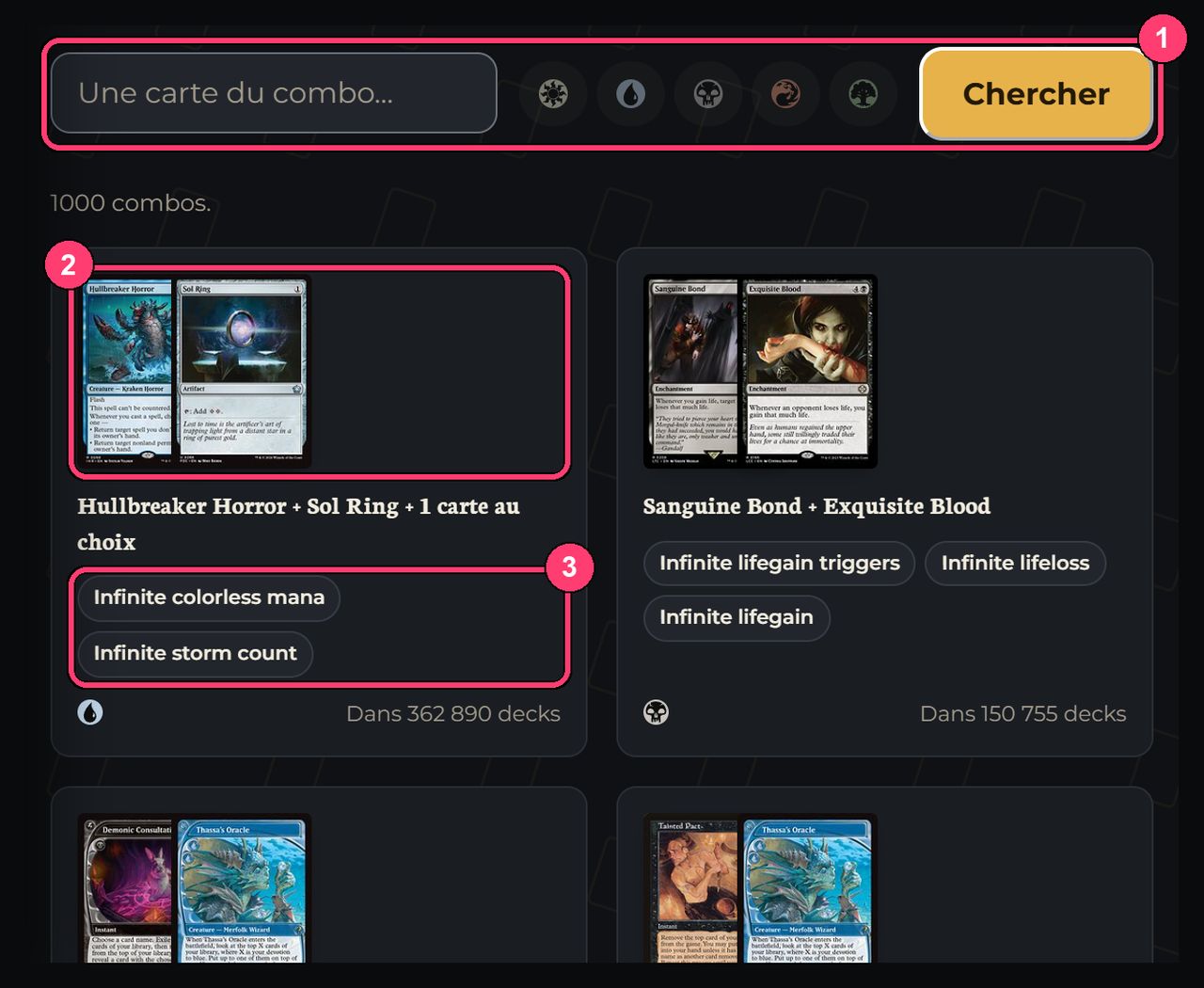
On the Combos page, one sentence sums up the goal: "The most played combos in Commander. Open one to see its cards, what you need in place and each step of the combo." Each combo appears there as a card with:
- the cards of the combo (for example Sanguine Bond and Exquisite Blood);
- the results it produces, as badges, like "Infinite lifegain", "Infinite colorless mana" or "Win the game";
- the colours the combo needs;
- the number of decks that play it, for example "In 150,755 decks".
At the time of the screenshot, the library held 1,000 combos, sorted from most to least played. The first, Hullbreaker Horror with Sol Ring and a card of your choice, appeared in 362,890 decks. Next came Sanguine Bond with Exquisite Blood (150,755 decks), Demonic Consultation with Thassa's Oracle (149,825 decks) and Tainted Pact with Thassa's Oracle (131,835 decks).
These numbers are a reference point, not a verdict. A combo played in a hundred thousand decks is not "better" than a rare combo: it is simply more widespread, so more likely to be met at your table. Knowing it is popular helps you recognize it when it comes.
Reading a combo's page
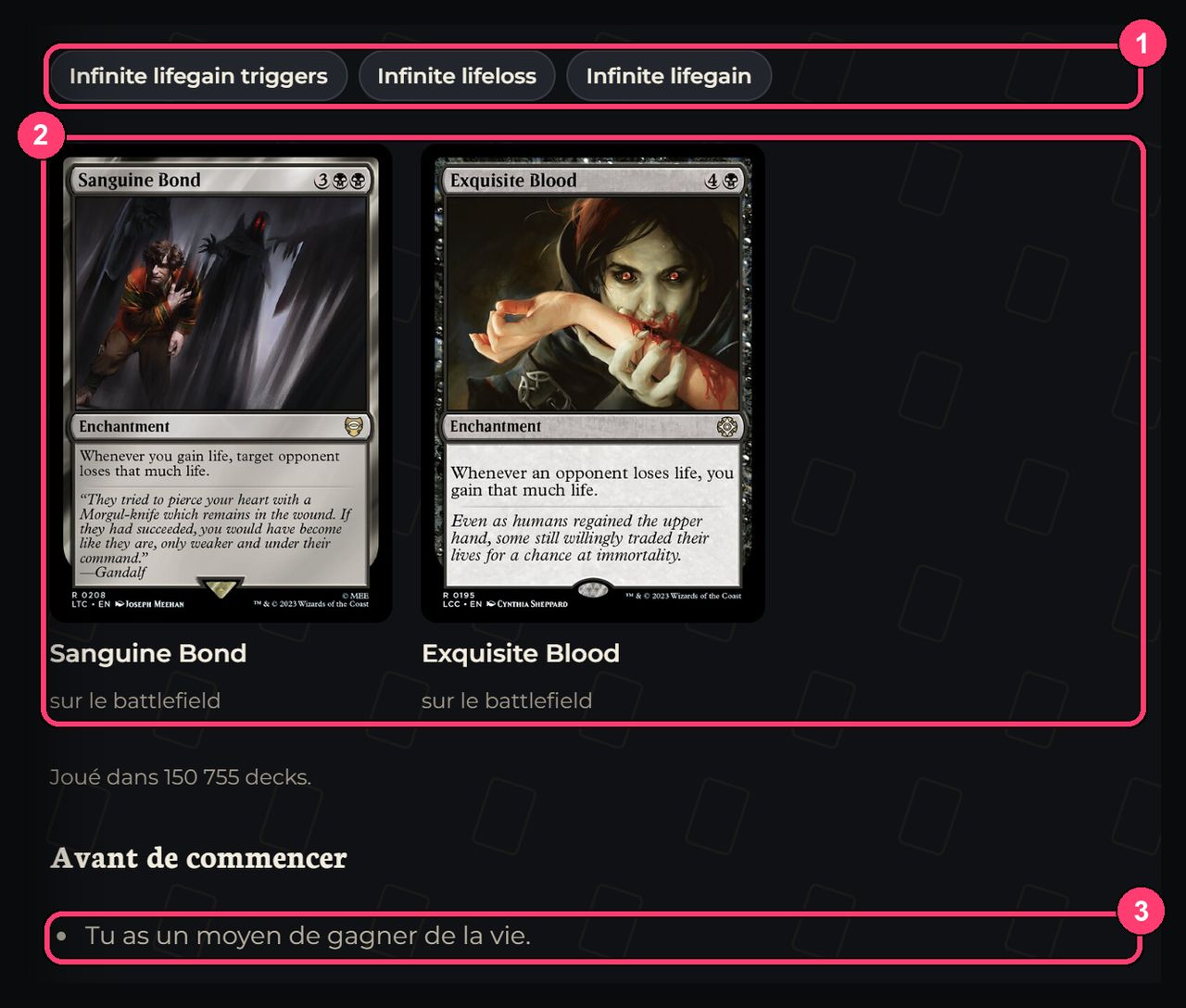
By opening a combo, you land on a page that explains everything. Take Sanguine Bond and Exquisite Blood, the second most played combo on the list. The page shows the two cards, with their required state (here, "on the battlefield" for each), the results (infinite life gain, infinite life loss) and the number of decks that play it. It then gives two blocks:
Before you start. What you need in place before starting the loop. For this combo: "You have a way to gain life". Both enchantments are on the table, and all that is missing is a first life gain to kick things off.
Steps. The loop, written step by step: you gain life; Sanguine Bond triggers and an opponent loses that much life; Exquisite Blood triggers because an opponent lost life, and you gain that much life; start again from step 2. Each turn of the loop makes an opponent lose life, which, repeated, eliminates the table.
The data comes from Commander Spellbook, a collaborative combo database, and the page says so in its footer. It is a serious source, but no database knows every combo: an absence from the library does not prove a combination is harmless.
Two more combos from the list, unpacked
Demonic Consultation and Thassa's Oracle. The library lists "Exile your library" and "Win the game" as results. The principle fits in two steps. Demonic Consultation has you name a card, then exiles cards from the top of your library until the named card shows up: if you name a card that is not in your library, the whole library goes. Thassa's Oracle, cast afterwards, looks at the top of a now empty library and makes you win the game. It is a short combo, with no loop, which mostly asks that you not mistake the named card. The same family includes Tainted Pact with Thassa's Oracle, fourth on the list.
Vito, Thorn of the Dusk Rose and Exquisite Blood. The same results as Sanguine Bond with Exquisite Blood (infinite life gain and loss), with a different starting piece. It is a good example of how a combo comes in variants: one card replaces another without changing the principle. Once you know the principle, you recognize its variants at a glance.
These two pages read like the others: cards, result, what you need in place, then the steps. If a step seems obscure to you, it is a sign you should reread the cards' text before playing them.
Searching for your deck's combos
The top of the page offers two tools so you do not have to scroll through a thousand combos:
- A "A card from the combo…" field: type the name of a card in your deck and the library keeps only the combos that use it. It is the fastest way to check that a "nice" deck does not hide a combo.
- Your deck's colours: five mana icons (white, blue, black, red, green) filter the combos your colour identity allows you to play. A green-white deck does not need to see a combo that requires red.
A simple method for auditing a deck:
1. List the ten most powerful cards in your deck (tutors, card draw, fast mana, creatures with loop effects). 2. Search each of them in the library, keeping the colour filter on. 3. Note the combos that appear with another card you already play. 4. Decide, for each, whether it is intended (you play it), tolerated (you keep it but you say so) or accidental (you remove one of the cards).
This method takes a quarter of an hour and avoids the bad surprise of winning in one go without having looked for it.
Vocabulary to know
A few terms come back in the library's badges:
- Infinite: a quantity that grows without limit at each turn of the loop (mana, draws, tokens).
- Near-infinite: an enormous but finite number, large enough to win. Underworld Breach with Brain Freeze, for example, is described as near-infinite.
- Storm count: the counter of spells cast during the turn. When it climbs without limit, a spell with "storm" copies itself that many times.
- Triggers: abilities that trigger. "Infinite lifegain triggers" means the ability that gains life triggers endlessly.
- Win the game: the combo wins the game on the spot.
- 1 card of your choice: the combo needs an extra card of a specific type, which you pick among several possibilities.
Card names stay in English: it is the vocabulary used at the table.
Why combos count for power level
In the Commander brackets system, two-card combos are part of the criteria. A deck that contains one quickly exceeds the level of a relaxed game, even if it plays no expensive card. On Tapt's preconstructed decks page, the bracket marker says it in one line: "Two-card combos (none before bracket 3)".
Tapt counts the two-card combos your deck already assembles, according to Commander Spellbook, and draws a floor from that count: if a combo is present, your deck cannot be below a certain level. The nuance matters. The marker does not say the combo is dangerous or that it is played early: it only says it exists. It is up to you to judge at what turn you would assemble it in practice.
See the Commander Brackets page for the detail of the system, and the article on preconstructed decks to see how the marker shows on ready-made decks.
Talking about a combo at your table
A combo only becomes a problem if it surprises. A few habits avoid tension:
- Announce it before the game. "My deck contains Thassa's Oracle with Demonic Consultation": one sentence, and nobody feels trapped.
- Say at which turn you aim for it. A combo planned for turn ten does not have the same effect as a combo that can land on turn four.
- Say how to stop it. A player who knows that a specific card cuts your combo (a counterspell, an enchantment removal) plays more comfortably.
- Stay open to removing a card. If the table does not like your combo, removing a single piece costs little and keeps the evening pleasant.

Buying the cards of a combo
A combo is played with all its pieces, and their prices vary from one store to another. To know what assembling the two or three cards will cost you, open the card comparator for each. If you would rather know what the complete deck that hosts it costs, paste the list into the deck comparator: it gives you the best price store by store, and a purchase suggestion that accounts for shipping.
One last tip: before buying, check that you really want this combo in your deck. Many players find out afterwards that a combo that wins fast takes the fun out of the game.

Frequently asked questions
Where do the library's combos come from?
From Commander Spellbook, a collaborative combo database. Each page mentions it. Tapt shows them and uses them for its bracket marker.
Is a two-card combo always forbidden?
No. Nothing is "forbidden": brackets are a vocabulary to agree at the table. A two-card combo is simply an element that pushes a deck toward the higher levels, and that is better announced.
Does the library contain every combo?
No. It lists a thousand of the most played combos. Others exist, and no database knows them all.
How do I know if my deck contains a combo?
Search your cards one by one in the "A card from the combo…" field, or build your deck in the decks section: Tapt looks for the two-card combos the list already assembles and takes them into account in its bracket marker.
Why do some combos ask for "1 card of your choice"?
Because the combo works with any card of a specific type. The combo's page explains which one.
Going further
Open the combo library, search for a card from your deck and read a combo's page from start to finish: the steps written one by one are the best way to learn. To place your whole deck, reread the article on Commander brackets.
- Commander combos
- infinite Magic combo
- Thassa's Oracle combo
- Commander Spellbook
- two-card combo
- combo library
Comments 0
Sign in or create your account to leave a comment.
No comments yet.