


Commander brackets explained: the 5 power levels
By The Tapt team · updated
The five Commander brackets, the Game Changers list and how to tell your table what level your deck plays at, before anyone shuffles a single card.

Every Commander player has lived this game: a deck polished for two years shows up at a table of preconstructed decks, the game is over before it started, and nobody had fun. The problem is not that one of the decks is "bad": it is that nobody said what level they were playing at. Brackets exist for that. They give you a shared vocabulary to agree at the table before shuffling.
This guide explains what brackets are, what each of the five levels means, what the Game Changers list is and how it sets concrete limits, what Tapt can tell you about your deck (and why it does not give you a bracket but a marker), and how to lead the conversation at the table so everyone has a good evening.
Why a system of levels
Before brackets, people talked about "power out of ten". The number meant something different to each person: for one, a 7 is a deck that wins around turn eight; for another, it is a deck with nice expensive cards. Two players in good faith could say "my deck is a 6" and not be talking about the same deck.
Brackets replace that fuzzy number with five levels described by what the deck does: speed, combos, very powerful cards, resources. Wizards of the Coast published them in 2025 as an official system. It is not a rule of the game: nobody forces you to play at a level, and a judge will not disqualify you for a misclassified deck. It is a conversation tool, like saying "we are playing a relaxed game" or "we are here to win".
The system is presented as evolving: it is reviewed regularly, and the list of cards that sets it moves with it. What is true today may change at the next revision.
The five levels
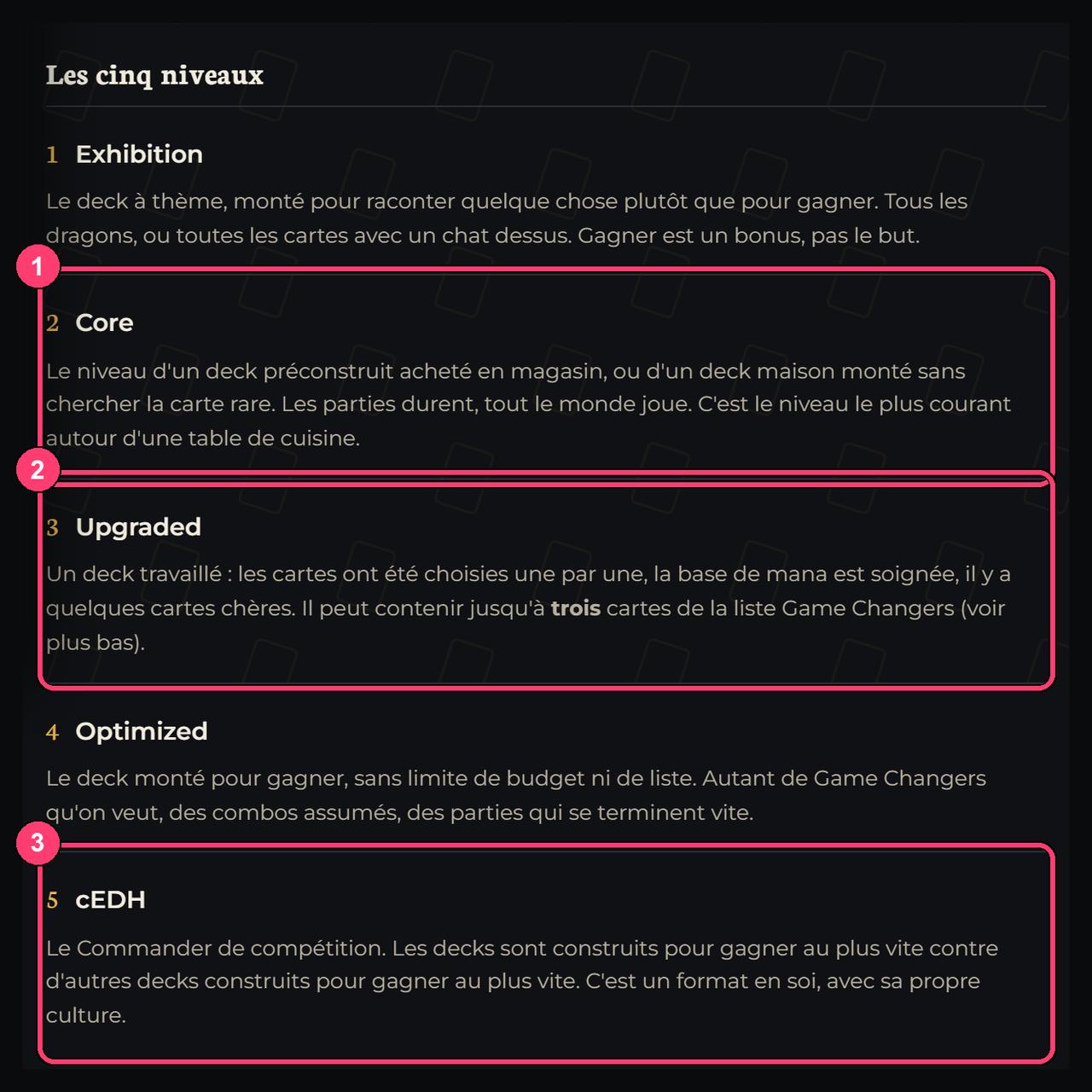
1. Exhibition. The theme deck, built to tell something rather than to win. All the dragons, or all the cards with a cat on them. Winning is a bonus, not the goal. It is the level of games where you laugh at whatever happens.
2. Core. The level of a preconstructed deck bought in a store, or of a homemade deck built without chasing the rare card. Games last, everyone gets to play. It is the most common level around a kitchen table, and where most players should start.
3. Upgraded. A worked deck: the cards were chosen one by one, the mana base is polished, there are a few expensive cards. It can contain up to three cards from the Game Changers list. It is the level where you start to feel the difference with a precon.
4. Optimized. The deck built to win, with no budget or list limit. As many Game Changers as you want, assumed combos, games that end fast.
5. cEDH. Competitive Commander. The decks are built to win as fast as possible against other decks built to win as fast as possible. It is a format of its own, with its own culture and its own expectations.
One point to remember: a higher bracket is not "better". A bracket 1 deck that makes a table of four friends laugh does its job better than a bracket 4 that crushes players who came to relax. The right bracket is the one that fits the table.
The Game Changers list
A large part of the difference between the levels plays out on a short list of cards. Wizards keeps a list of 53 cards judged powerful enough to change the nature of a game on their own: the Game Changers. It serves as a guardrail:
- a bracket 1 or 2 deck contains none;
- a bracket 3 deck accepts up to three;
- beyond that, you are in bracket 4 or 5, with no limit.
The list is reviewed every three or four months by the Commander Format Panel, and Tapt re-reads it automatically every week. The last review took place on October 30, 2026. A few cards you will find on it, to give an idea: Rhystic Study, Cyclonic Rift, Smothering Tithe, The One Ring, Force of Will, Demonic Tutor, Orcish Bowmasters, Necropotence, Mana Vault and Gaea's Cradle.
Several families of cards appear: tutors, which find a specific card in the library (Demonic Tutor, Vampiric Tutor, Enlightened Tutor); fast mana, which speeds up the early game (Chrome Mox, Mana Vault, Grim Monolith); powerful card draw (Rhystic Study, Necropotence, Consecrated Sphinx); free or protective spells (Force of Will, Fierce Guardianship); and combo pieces (Thassa's Oracle, Underworld Breach, Ad Nauseam). That classification is ours, to help you file them in your head, not Wizards'.
Careful: the list does not contain every powerful card. A very strong card may not be on it, which is why a bracket does not boil down to a count. Counting Game Changers is the starting point of the conversation, not its conclusion.

Why Tapt shows a marker and not a bracket
On a Commander deck, Tapt shows a marker, not a bracket. The difference matters.
Wizards defines a bracket from four criteria. Tapt counts three of them:
1. the cards on the Game Changers list; 2. mass land denial, meaning cards that destroy every player's lands, according to the roles assigned by Scryfall; 3. the two-card combos your deck already assembles, according to the Commander Spellbook database.
The fourth criterion, extra turns, only counts when they are chained: Tapt flags them without drawing a conclusion.
Even those three criteria leave room for judgement. A combo may be meant for the end of the game, and no database knows every combo. Tapt therefore says what it can prove, a floor: "Bracket 3 and up" means your deck cannot be below that. The rest is for you and your table to judge. A tool that promised you your exact bracket would be lying to you.
The marker appears on your Commander decks in the editor, on the page of a shared deck, and on the preconstructed decks. The latter are a good way to calibrate your eye: the page lists nearly two hundred of them, with their contents and what they cost at local stores. The guide to preconstructed Commander decks explains how to read their pages.

Combos, the first place a deck "cheats" without knowing it
A deck that seems modest can contain a two-card combo that wins the game on the spot, sometimes without anyone having looked for it. That is why combos are part of the criteria.
The Tapt combo library lists a thousand of the most played in Commander. Each combo comes with its cards, what you need to have in place and each step to follow. The number of decks that play each combo also appears: at the time of the screenshot, some combos were in more than three hundred thousand decks. You can search by card, to see whether one of yours is part of a combo, or filter by colour. The Commander combos guide explains how to read a page.

If your deck contains a two-card combo, tell your table, even if you do not plan to play it early. It is information the other players will want to have.
An example to place a deck
Take a deck that contains Rhystic Study, Cyclonic Rift and Smothering Tithe, three cards from the list. It counts three: it can therefore still be a bracket 3, provided nothing else pushes it higher. Add The One Ring, a fourth card from the list, and the deck exceeds the bracket 3 limit: it moves up to at least bracket 4. Remove those four cards and it can drop back to bracket 2, if the rest of the list is sensible.
That is what the Tapt marker does on your deck: it counts the Game Changers, looks for two-card combos and mass land denial, then shows "Bracket 3 and up" or "Bracket 4 and up" when it can prove it. It never says "your deck is exactly bracket 2", because a deck with none of those three signals can still be faster or sharper than its list suggests.
How to lead the conversation at the table
A bracket is only worth something if it is said out loud. A few habits are enough:
1. Announce your bracket before shuffling. "My deck is a bracket 2, and yours?" One sentence, thirty seconds, and everyone knows what to expect. 2. Show the cards that matter. If your deck contains Game Changers, name them. If you have a combo, explain it. 3. Talk about your deck, not your worth. Saying your deck is bracket 4 is not bragging, and saying it is bracket 2 is not apologizing. 4. Accept adjustment. If your deck is clearly stronger than the table, take a lighter deck, or remove a few cards for the game. Nobody will hold it against you. 5. Come back to it after the game. "Was it too fast? Too slow?" The best calibration comes from your own table.
When you forge a new deck, decide the bracket before choosing the cards, not after. It is much simpler to build a bracket 2 on purpose than to downgrade a bracket 4 by removing cards you love.
Budget, a poor indicator
An expensive deck is not necessarily strong, and a cheap deck can be formidable. A card's price depends on its rarity and its appeal to collectors, not only on its power: a card can be very expensive without changing a deck's level, and the reverse exists too.
That said, building a high-bracket deck often costs more, because fast mana and sought-after tutors weigh on the bill. To know what your deck really costs, the deck comparator calculates the total store by store. And if a key card is too expensive today, track its price rather than paying at the worst moment.

Frequently asked questions
Are brackets mandatory?
No. It is not a rule of the game, it is a shared vocabulary to agree at the table. Nobody forces you to adopt it, but many groups use it to avoid lopsided games.
What is a Game Changer?
A card from the list of 53 cards that Wizards judges powerful enough to change the nature of a game on their own. A bracket 1 or 2 deck contains none, a bracket 3 accepts up to three, and a bracket 4 or 5 has no limit.
Why doesn't Tapt give me my exact bracket?
Because it cannot compute it with certainty: it counts three of Wizards' four criteria, and those leave room for judgement. Tapt gives you a floor, meaning what it can prove, and lets you conclude with your table.
Is a precon always a bracket 2?
It is the typical level of a preconstructed deck bought in a store, but every deck is different. The Tapt marker, shown on each precon's page, gives you a starting indication.
Can the Game Changers list change?
Yes. It is reviewed every three or four months by the Commander Format Panel, and Tapt re-reads it every week to stay up to date.
Going further
Paste your list into the deck comparator or build it in the decks section to see your deck's bracket marker. The detail of the system is also on the Commander Brackets page. To understand where the prices you will see along the way come from, read the guide to comparing the price of a Magic card. If you play cards that change who controls the table, like the monarch title, also read the article on the monarch in Magic.
- Commander brackets
- Commander power level
- cEDH
- Game Changers
- EDH power level
- bracket 3
Comments 0
Sign in or create your account to leave a comment.
No comments yet.