


The most played Commander cards: the top 100
By The Tapt team · updated
The top 100 Commander cards, read by type, cost and role: what players put in every deck, why, and what these cards cost in Quebec.

You are building your first Commander deck and you wonder which cards everyone plays, and why. There is a numbered answer: a ranking of the cards players put most often in their decks. Tapt shows the top 100 on its Popular cards page, updated every day.
A list of a hundred names does not say much on its own. This guide reads it for you: where the ranking comes from, what it really contains (almost half are lands), the big families of cards that keep coming back, the seven Game Changers that slip in, and what these cards cost in local shops. You will leave with a clear idea of what goes into a deck before you even pick your commander.
Where the ranking comes from
The ranking is not Tapt's opinion. It comes from the EDHREC popularity rank, as Scryfall publishes it for every card. EDHREC is a site that collects players' Commander decks, and Scryfall, the reference database for Magic cards, carries that rank in the data it makes available to software. Tapt reads that rank every day in its own card database, keeps the first hundred and displays them.
One point is worth saying: Tapt no longer calls EDHREC directly. The site has terms of use that limit automated use, so Tapt goes through Scryfall, which allows that use in Magic software.
What the rank measures is presence in decks, not power or value. A card can be everywhere because it is excellent, because it is cheap, or because it fits almost any deck. Keep that nuance in mind for the rest of this guide.
What the top 100 really contains
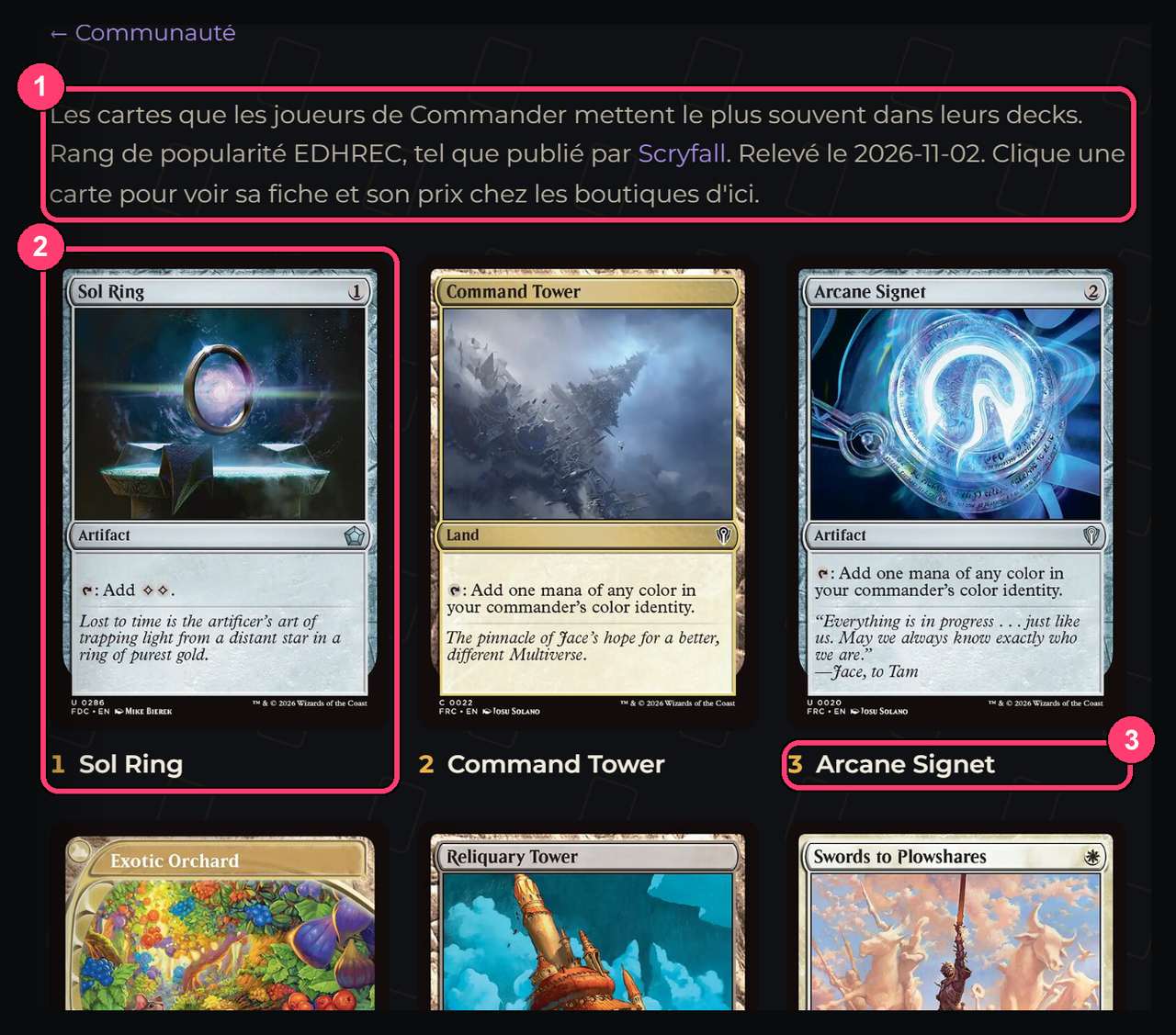
To understand the list, we sorted the hundred cards of November 2, 2026 by main type. The result often surprises people:
- Lands: 48
- Instants: 17
- Sorceries: 13
- Artifacts: 12
- Creatures: 5
- Enchantments: 5
Almost half of the most played cards are lands, and only five are creatures. That is no accident: a land fits any deck of the right color, while most creatures only make sense in a specific strategy. The top 100 therefore measures what is useful to everyone, not what is strongest.
Another finding: among the 52 cards that are not lands, 34 cost two mana or less. The most played cards are almost all cheap to cast. That makes sense in multiplayer, where you want cards that slot into any turn without clogging the rest of your hand.
Lands, almost half of the ranking
A land that costs no mana and no tempo is the base card of a deck. Here is what the top 100 reveals about them.
- Command Tower (second in the ranking) adds one mana of any color in your commander's color identity. In a multicolor deck, it fixes mana problems on its own.
- Exotic Orchard (fourth) adds one mana of any color that a land an opponent controls could produce. It works well in multiplayer, where there is almost always an opposing land that makes what you need.
- Evolving Wilds (fourteenth) sacrifices itself to fetch a basic land. It costs almost nothing, fits every deck, and fixes your mana.
- Bojuka Bog (nineteenth) exiles a player's graveyard when it enters. It does two things at once: a land and an answer to decks that reuse their graveyard.
- Rogue's Passage (thirteenth) makes a creature unblockable for four mana. A land that doubles as a finisher.
You will also find all the big families of dual lands: lands that fetch another land (fetch lands such as Polluted Delta, Flooded Strand or Misty Rainforest), "shock" lands (Watery Grave, Steam Vents, Blood Crypt) and "check" lands (Sulfur Falls, Glacial Fortress). They are played in almost every deck of two or more colors, and they keep their place in the ranking because they never change a deck's strategy, only its consistency.
Mana sources and the opening draw
After lands, the cards that speed up your mana are the most present. The most played are almost always artifacts costing one or two mana.
- Sol Ring is first in the ranking. For a single mana, it adds two colorless mana each time you tap it. It is pure acceleration, and every deck can play it because colorless mana is useful everywhere.
- Arcane Signet (third) produces one mana of any color in your commander's color identity, for two mana. It is the pocket version of Command Tower.
- Fellwar Stone (twelfth) does the same but based on your opponents' lands, like Exotic Orchard.
- Cultivate (fifteenth) fetches two basic lands: one enters tapped, the other goes to your hand. It accelerates and fixes mana in a single card.
What they share: none of these cards wins the game. They make your deck work. That is probably the most useful lesson of the ranking: before you choose your flashy cards, make sure your mana works.
Removing, countering, protecting
The third group gathers the cards that answer what others do, or protect what you do. It takes up a large part of the first twenty places.
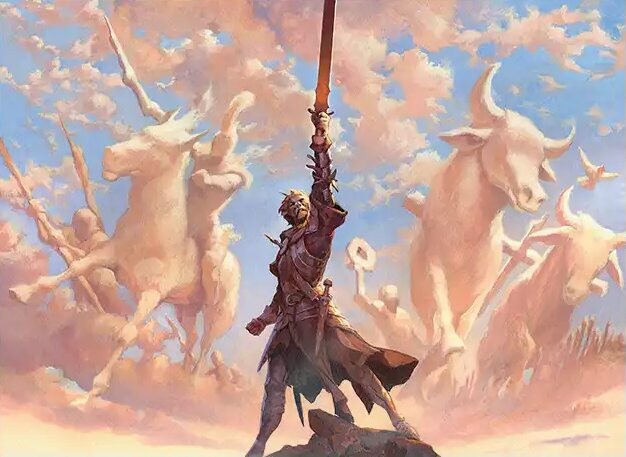
- Swords to Plowshares (sixth) exiles target creature, and its controller gains life equal to its power. For one white mana, it is one of the cheapest answers in the game.
- Path to Exile (tenth) does almost the same, but the controller may search for a basic land. A small gift for the same efficiency.
- Counterspell (eleventh) counters a spell for two blue mana. The text fits in three words.
- Beast Within (twentieth) destroys any permanent, but its controller gets a 3/3 Beast token. An answer to anything, at the price of a gift.
- Blasphemous Act (seventeenth) deals 13 damage to each creature. Its cost drops by one mana for each creature on the battlefield: in a four-player game, it often costs much less than its printed cost.
- Heroic Intervention (twenty-third) gives your permanents hexproof and indestructible until end of turn. It is the shield against board wipes.
- Swiftfoot Boots (seventh) and Lightning Greaves (eighth) give haste and protection (hexproof for the first, shroud for the second) to a creature. They protect your commander and let it attack right away.
What this family has in common: they are cheap cards (one to three mana) that react. Commander players know an opponent will play something dangerous, and they want the answer in hand.
The cards that make the deck run
A few cards in the ranking are neither lands nor answers: they create value over time.

- Skullclamp (thirty-fourth) gives the equipped creature +1/-1, and when it dies, you draw two cards. It costs one mana and equips for one mana. With 1/1 tokens, the creature dies right away, and each equip earns you two cards.
- Rhystic Study (forty-first) lets you draw a card whenever an opponent casts a spell, unless they pay one mana. Many players forget to pay, and the cards pile up.
- Smothering Tithe (sixty-third) gives you a Treasure token whenever an opponent draws a card, unless they pay two mana. It accelerates you with no effort.
These three cards have one thing in common: they are passive. They work while the others play, without you having to do anything. That explains their popularity in multiplayer games, where every turn of the others is an opportunity.
Seven Game Changers in the top 100
In the top 100, seven cards belong to the Game Changers list, the Wizards of the Coast list that sets limits by power level: Rhystic Study, Cyclonic Rift, Demonic Tutor, Smothering Tithe, Ancient Tomb, Fierce Guardianship and The One Ring. That means seven cards out of a hundred count toward the bracket quota.
This detail matters when you build your deck. If your group plays brackets 1 or 2, none of these seven cards is allowed. At bracket 3 (Upgraded), the deck can hold up to three. The Commander Brackets page and our article on Commander brackets explained detail these limits. Before copying a ranking, ask yourself what level your table plays at.
Note also that Ancient Tomb is a land: it adds two colorless mana and deals two damage to you. It is a good example of a popular card that is also a power lever: its rank in the ranking hides the fact that it counts toward your Game Changers quota.
What they cost in Quebec
The top 100 cards are almost all printed in several sets, and the price changes a lot depending on the printing. Tapt compares each card across local shops.
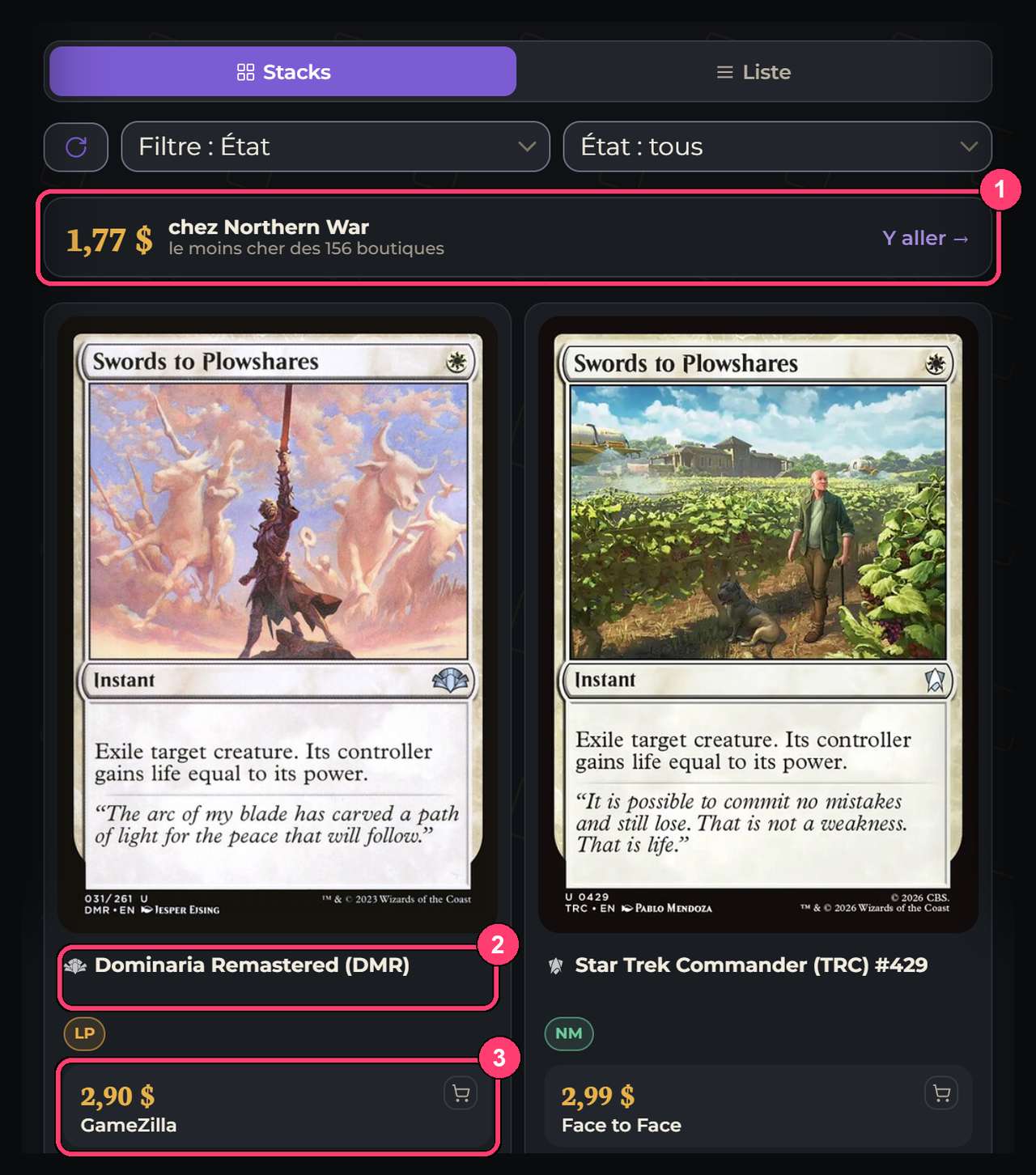
That day, the lowest price for Swords to Plowshares was $1.77 at Northern War, out of 156 shops. The Dominaria Remastered printing cost $2.90 at GameZilla, in LP (lightly played) condition. Same card, same text, different prices depending on the printing and the shop.
To know when a card in the ranking drops, Tapt's price tracking warns you. To understand how we compare, our guide to comparing the price of a Magic card in Quebec explains the method, and the one on tracking a card's price shows how to set an alert.
How to use it to build a deck
The top 100 is a good starting point, but it does not replace your own judgment. Here is how to use it.
- Start with lands and mana. Sol Ring, Arcane Signet, Command Tower and a few dual lands in your colors solve half of a deck's problems, for a few dollars.
- Add cheap answers. One or two cards like Swords to Plowshares or Counterspell, depending on your colors. Better to have few and choose them well.
- Keep room for your strategy. If you fill the whole deck with the most played cards, it will look like everyone else's. Leave the rest of the deck to your commander.
- Count your Game Changers. If you have more than three, your deck is no longer at bracket 3.
- Compare prices before buying. A cheaper printing does exactly the same thing in play.
For those who prefer to start from a deck that is already built, our preconstructed Commander decks show what each one contains, and a good part of the cards in this ranking are already in them.
Frequently asked questions
Is the top 100 the same for every commander? Yes, it is a general ranking, not one per commander. It shows what comes up most often everywhere. For a specific commander, the most played cards will be different.
Why are there so few creatures in the ranking? Because creatures depend on the deck's strategy. A land or a mana artifact goes into almost every deck, while a specific creature only makes sense in a few. The ranking measures what is useful to everyone.
How often does the ranking change? Tapt recalculates it every day from the rank published by Scryfall.
Is a popular card necessarily good in my deck? No. The rank measures presence in decks, not quality for your deck. A card can be everywhere and do nothing in your strategy.
Are the top 100 cards expensive? Many cost a few dollars, but a few, like The One Ring, cost much more. The price depends on the printing: always compare before buying.
Going further
The top 100 is a snapshot of what players play, not a list to copy. Visit the Popular cards page to see today's ranking, use the comparison tool to find each card at the best price, and reread the guide to Commander brackets before deciding how many powerful cards to put in your deck.
- most played Commander cards
- Commander top 100
- Commander staples
- Sol Ring
- Swords to Plowshares
- Game Changers
- popular EDH cards
Comments 0
Sign in or create your account to leave a comment.
No comments yet.