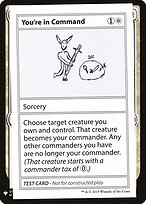
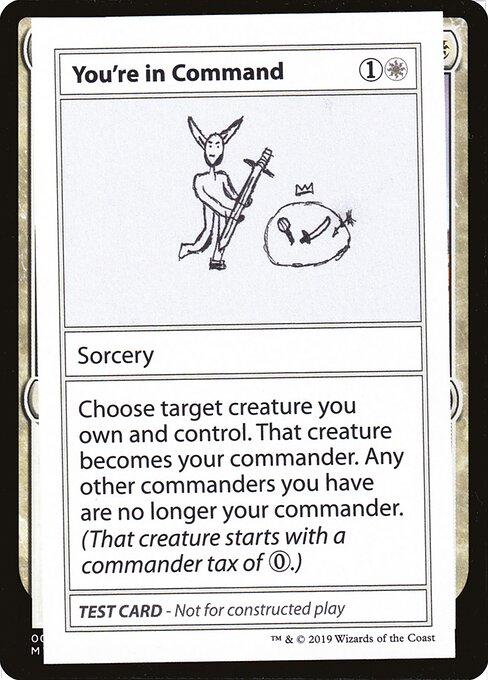
Choose target creature you own and control. That creature becomes your commander. Any other commanders you have are no longer your commander. (That creature starts with a commander tax of .)
If you cast You’re in Command targeting a token and that token leaves the battlefield, it ceases to exist. Why did you put a token in charge?
2019-11-12 · Wizards of the Coast
If you have a commander in the command zone as You’re in Command resolves, that card is no longer your commander. It remains in the command zone and can’t be cast.
2019-11-12 · Wizards of the Coast
If You’re in Command targets a creature that’s represented by multiple cards, each of those cards become your commander. The additional cost to cast them and combat damage dealt by them are tracked separately for each card. Damage dealt while they’re together representing one creature counts for each of those commanders.
2019-11-12 · Wizards of the Coast
To become your commander, the following things are true: If your commander would be put into a zone other than the stack or battlefield, you may put it into the command zone instead. You may cast that commander from the command zone. You pay an additional {2} for each time you’ve cast it from the command zone this game. If a commander has dealt 21 combat damage to a player while it’s a commander, that player loses the game. Damage dealt before it was your commander isn’t counted.
2019-11-12 · Wizards of the Coast
If a card becomes your commander during a game, no deckbuilding rules of the Commander variant apply. You can still play cards that don’t correspond to that commander’s color identity.
2019-11-12 · Wizards of the Coast
You’re in Command gives you a commander even if you’re not playing a Commander game.
🍪 Tapt uses cookies and measurement tools to make the site work. With your consent, it also uses optional ones to understand how the site is used and to improve it. Learn more.
Essential cookieKeeps you signed in from one page to the next. Without it, the site does not work.
Always on
Internal audience measurementPages visited, cards searched, approximate city, and an anonymous session token that links your actions for the length of your visit (random, with no name or IP address, erased when you close the tab). Stays with Tapt, never shared. If refused, traffic is still counted but nothing is tied to you.
Third-party toolGoogle Analytics (traffic statistics, shortened IP address). It sets its own cookies and receives data from your visit, sometimes outside Quebec. If refused, nothing is loaded. You can subscribe to the newsletter either way: your address is only sent when you click Subscribe.





 .)
 I Want That Stuff