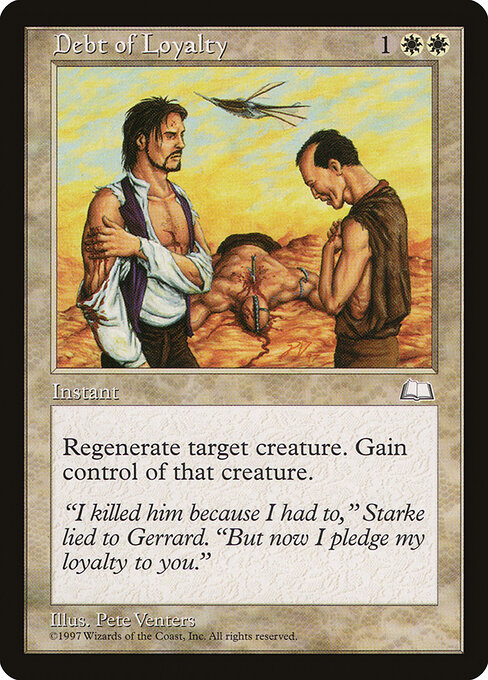
Casting Debt of Loyalty puts a regeneration shield on a creature. If, later in the turn, that creature would be destroyed, instead it regenerates and you gain control of it. Note that it will be tapped when you gain control of it. The control change has no duration; you’ll retain control of that creature until the game ends or until some other effect causes it to change control.
2008-04-01 · Wizards of the Coast
If a creature has two regeneration shields on it — one from a Debt of Loyalty you cast and one from another effect — and it would be destroyed, its controller chooses which regeneration shield to use. If that player chooses to use the Debt of Loyalty shield, you’ll gain control of the creature. If the player chooses to use the other shield, you won’t gain control of the creature, but the Debt of Loyalty shield will remain on that creature for the rest of the turn (in case it would be destroyed again).
2008-04-01 · Wizards of the Coast
If you cast Debt of Loyalty but nothing happens to the targeted creature for the rest of the turn that would cause it to be destroyed, Debt of Loyalty has no visible effect. The regeneration shield wears off at the end of the turn. If the creature regenerates during a later turn, you won’t gain control of it.
2008-04-01 · Wizards of the Coast
You may cast Debt of Loyalty targeting a creature you already control. If you do, and that creature would be destroyed later in the turn, it will regenerate and you’ll gain control of it (though gaining control of a creature you already control usually has no visible effect).
2008-04-01 · Wizards of the Coast
A creature with indestructible never needs to regenerate, so Debt of Loyalty will have no effect on it.
🍪 Tapt uses cookies and measurement tools to make the site work. With your consent, it also uses optional ones to understand how the site is used and to improve it. Learn more.
Essential cookieKeeps you signed in from one page to the next. Without it, the site does not work.
Always on
Internal audience measurementPages visited, cards searched, approximate city, and an anonymous session token that links your actions for the length of your visit (random, with no name or IP address, erased when you close the tab). Stays with Tapt, never shared. If refused, traffic is still counted but nothing is tied to you.
Third-party toolGoogle Analytics (traffic statistics, shortened IP address). It sets its own cookies and receives data from your visit, sometimes outside Quebec. If refused, nothing is loaded. You can subscribe to the newsletter either way: your address is only sent when you click Subscribe.





 Level Zero Games · Condition DMG