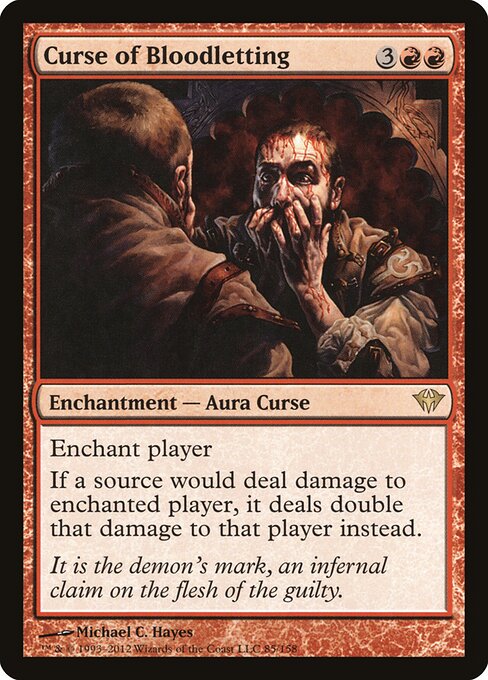
If multiple effects modify how damage will be dealt to the enchanted player, that player chooses the order to apply the effects. For example, Mending Hands says, “Prevent the next 4 damage that would be dealt to any target this turn.” Suppose a spell would deal 5 damage to enchanted player and that player has cast Mending Hands targeting themselves. The enchanted player can either (a) prevent 4 damage first and then let Curse of Bloodletting’s effect double the remaining 1 damage, taking 2 damage, or (b) double the damage to 10 and then prevent 4 damage, taking 6 damage.
2011-01-22 · Wizards of the Coast
The source of the damage doesn’t change. A spell that deals damage will specify the source of the damage, often the spell itself. An ability that deals damage will also specify the source of the damage, although the ability itself will never be that source. Often the source of the ability is also the source of the damage.
2011-01-22 · Wizards of the Coast
Curse of Bloodletting works with any damage, not just combat damage. It also doesn’t matter who controls the source of the damage that’s being dealt.
2011-01-22 · Wizards of the Coast
If more than one Curse of Bloodletting enchants the same player, damage dealt to that player will double for each one (two of them will end up multiplying the damage by four, three of them by eight, and four of them by sixteen).
🍪 Tapt utilise des témoins et des outils de mesure pour faire fonctionner le site. Avec ton accord, il en utilise aussi d'autres, facultatifs, pour comprendre comment le site est utilisé et l'améliorer. En savoir plus.
Témoin essentielTe garde connecté d'une page à l'autre. Sans lui, le site ne fonctionne pas.
Toujours actif
Mesure d'audience internePages visitées, cartes cherchées, ville approximative, et un jeton de session anonyme qui relie tes gestes le temps de ta visite (aléatoire, sans ton nom ni ton adresse IP, effacé à la fermeture de l'onglet). Reste chez Tapt, jamais partagée. Refusée, la fréquentation est encore comptée mais plus rien n'est rattaché à toi.
Outil de tiersGoogle Analytics (statistiques de fréquentation, adresse IP raccourcie). Il pose ses propres témoins et reçoit des données de ta visite, parfois hors du Québec. Refusé, rien n'est chargé. Tu peux t'abonner à l'infolettre dans tous les cas : ton adresse n'est transmise qu'au clic sur S'abonner.





 Jeuxjubes · État DMG